Asbestos in Popcorn Ceilings: What Ontario Homeowners Need to Know
How to tell if your popcorn ceiling contains asbestos, what Ontario rules require, what testing costs, and why scraping it yourself is the worst option.
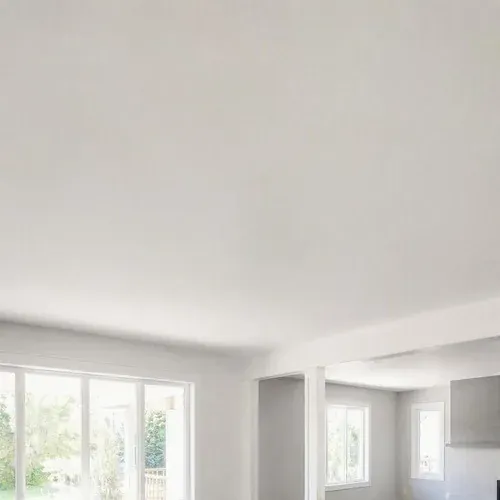
If your home was built before about 1990 and has a popcorn or stipple ceiling, there is a real chance the texture contains asbestos. This is the single most important thing to settle before anyone starts scraping, and it is also the thing most homeowners find out about halfway through a weekend project.
Here is the plain version, for Ontario, without the scare tactics or the shrug.
Why popcorn ceilings contain asbestos at all
Asbestos was added to ceiling texture because it worked. It made the material fire resistant, helped it bind and spray evenly, and it was cheap. From roughly the 1950s through the 1980s it was standard in textured ceiling products across North America.
Canada did not ban asbestos outright until 2018. The United States restricted it in ceiling texture in 1977, but existing stock kept being applied for years afterward, and Canadian supply chains ran on their own timeline. That is why the practical cut-off contractors use here is the early 1990s rather than any single legislative date.
Rough risk by era, for a Niagara home:
| Ceiling applied | Likelihood of asbestos |
|---|---|
| Before 1980 | High — assume it until tested |
| 1980 to 1990 | Moderate — testing strongly advised |
| 1990 to 2000 | Low — testing still cheap insurance |
| After 2000 | Effectively nil |
The complication in this region is that a lot of post-war housing through Facer Street, Merritton, Lakeport and the older parts of Welland and Niagara Falls picked up textured ceilings during a renovation in the 1970s or 1980s, not at the time the house was built. The build date on your deed does not tell you when the ceiling went up.
You cannot tell by looking
This is worth stating bluntly because it is the mistake that causes harm. Asbestos fibres are microscopic. There is no colour, texture, pattern or smell that distinguishes a ceiling containing asbestos from one that does not.
You will find advice online about judging by the size of the chunks or the sheen of the surface. It is worthless. Two ceilings that look identical can test differently.
What testing actually involves
A sample is taken from an inconspicuous spot, usually a closet or a corner, sealed, and sent to an accredited lab. In Ontario this runs roughly $60 to $150 per sample, with results back in a few working days.
Most single-storey homes need one or two samples. If different rooms were textured at different times, which happens more often than people expect, each era needs its own sample.
Take the sample wet. Misting the spot first keeps fibres out of the air, which matters because collecting a dry sample is itself a small disturbance of exactly the kind you are trying to avoid.
If you would rather not do that yourself, any contractor who does this work regularly can collect it during the quote visit. We do.
What happens if it is positive
The job changes from a scrape into licensed asbestos abatement. That means containment of the work area, negative air pressure, proper personal protective equipment, and disposal through a licensed waste stream.
In cost terms, expect roughly $12 to $22 per square foot against $3 to $6 per square foot for a straightforward removal. That is three to four times the price, which is why guessing in either direction is expensive. Assuming positive means paying for abatement you may not need. Assuming negative means potentially exposing your household.
Ontario Regulation 278/05 governs asbestos work on construction projects and in buildings, and it applies to anyone working in your home commercially. A contractor who offers to scrape a pre-1990 ceiling without asking about testing is telling you something important about how they work.
The option most people do not consider
You do not have to remove it.
Asbestos in ceiling texture is dangerous when it is disturbed and the fibres become airborne. Left sealed and undisturbed, it is not doing anything. That is the entire basis of encapsulation.
Boarding over the existing ceiling with new drywall seals the texture permanently, gives you the flat modern ceiling you wanted, and avoids abatement entirely. It costs meaningfully less than removal-with-abatement, and it drops your ceiling height by about half an inch, which nobody notices.
For a room with eight-foot ceilings and a positive test, this is very often the right answer. We will tell you so.
What not to do
Do not dry scrape it. This is the worst possible approach. Dry scraping puts the maximum number of fibres into the air and spreads them through the house on the HVAC system.
Do not sand it. Same problem, worse.
Do not skim over it without checking adhesion. Not an asbestos issue, but a practical one: texture that has been painted often will not hold a skim coat, and you will be back inside a year.
Do not let a contractor talk you out of testing. A $60 test against a job that costs thousands either way is not a close call.
If your test comes back clean
Then you have a straightforward job, and it is one of the most satisfying renovations there is. Masking, wetting, scraping, skimming the ceiling flat, sanding, and handing over a paint-ready surface. See popcorn ceiling removal for how the work runs and what it costs.
If only part of the ceiling is damaged and you would rather keep the texture, textured ceiling and wall repairs is the cheaper path — though note that patching a ceiling that tests positive still disturbs the material.
For full pricing on both routes, including the abatement figures above in context, see our Niagara drywall cost guide.
The short version
Test first. It costs less than a tank of gas and it is the only way to know. If it is clean, scrape it. If it is positive, choose between abatement and encapsulation with real numbers in front of you rather than a guess.
We quote both routes across St. Catharines, Niagara Falls, Welland and the rest of the region, and we will collect the sample while we are there.