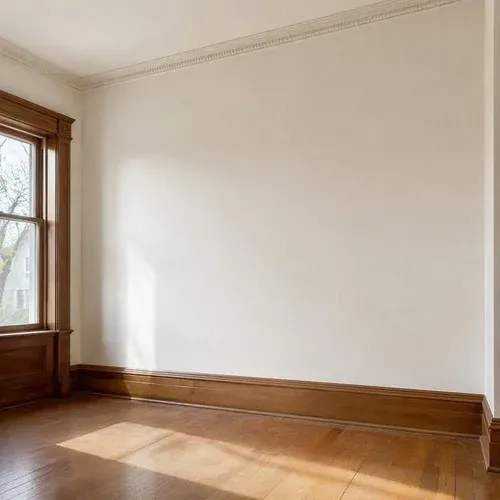
Plaster Repair
Lath and plaster in century homes fails differently than drywall. We repair it as plaster, not by patching it like board.
Plaster Repair ›
St Catharines Elite Drywall restores plaster crown moulding, cornice and ornamental plasterwork in period properties across the Niagara Region. Niagara-on-the-Lake's Old Town, Victorian and Edwardian homes in St. Catharines, and heritage properties through Welland, Port Colborne and Niagara Falls.
We repair cracked and separated cornice runs, replace missing or broken decorative sections, restore water damaged moulding, recover detail buried under decades of repainting, and carry profiles through where a wall has been removed or an opening widened. Where an intact section survives, the profile is taken from it and new work is formed to match the original.
In a period room the cornice is usually the feature that makes it one, and a clumsy repair is more visible than the damage was. We will also tell you honestly when modern MDF or polyurethane moulding is the sensible choice instead. More than twenty years, fully insured and WSIB covered.
In a period room, the cornice is usually the thing that makes it a period room. Take it away and you have a rectangular space with tall ceilings. Leave it damaged and it is the first thing anyone looks at.
Which is the awkward truth about this work: a bad repair to ornamental plaster is more visible than the damage was. A broken run at least reads as age. A clumsy patch reads as a decision somebody made.
That is why this is specialist work, and why we treat it separately from general plaster repair.
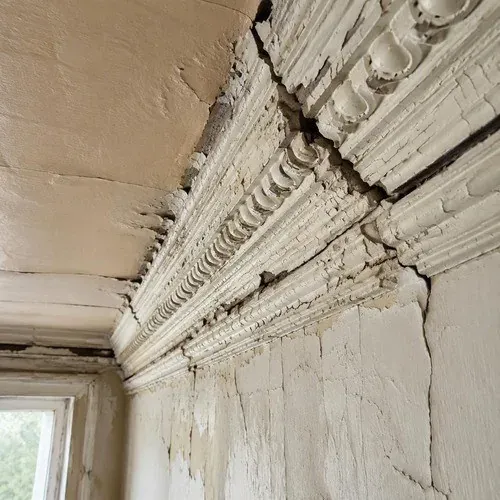
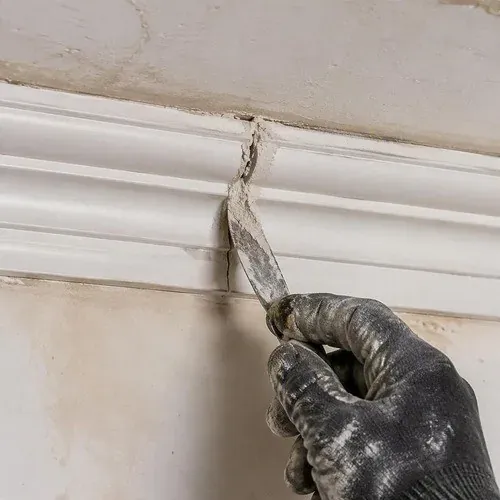
Movement in the building opens the joint where the cornice meets the wall or ceiling. Common in older Niagara homes that have been through a century of freeze-thaw cycles.
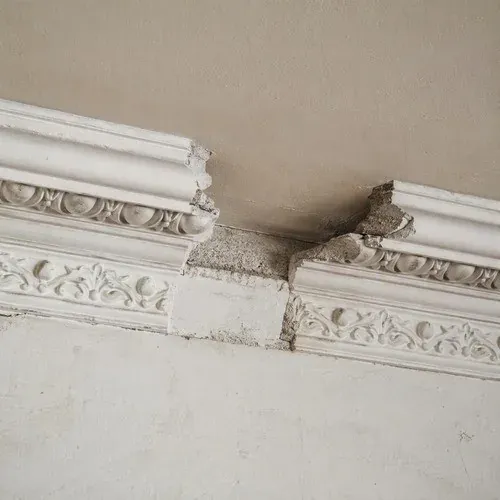
Damage from a knock, from a previous renovation that cut through a run, or from a section that simply failed and came down.
Roof and plumbing leaks reach cornices first, because they sit at the top of the wall. Plaster softens, detail dissolves, and the section loses its grip.
Extremely common, and often the most satisfying thing to fix. Eighty years of repainting can fill an ornate profile until it reads as a vague lump. The detail is usually still under there.
A wall removed, an opening widened, or an addition built. The cornice has to carry through the new work convincingly, and a straight stop looks unfinished.
This is the craft, and it is the reason the service commands a premium over standard drywall work.
An intact section of the existing run is used to capture the exact shape, either by templating it directly or by taking an impression. This is the step that determines whether the finished result reads as original.
For a continuous moulding, new plaster is run in place using a shaped template drawn along the run, building the profile up in passes exactly as it was originally formed. It is a slow process and it produces something that matches because it was made the same way.
Where the moulding carries repeating decorative elements rather than a run profile, a mould is taken from an intact piece and new elements are cast, then fitted and blended in.
A run profile taken from an intact section can generally be matched very closely. Hand-modelled ornament with no surviving example is far harder, and in some cases the honest answer is that it can be approximated but not reproduced. We will tell you which of those you are dealing with before you commit.
Most of this work comes from a handful of pockets in the region.
holds the densest concentration of surviving nineteenth century interiors in the area, and plaster cornices are common in those properties.
particularly the Glenridge area, Yates Street and the north end, where Victorian and Edwardian homes retain original ornamental work.
have substantial stock from the canal and industrial era, including properties with more modest but still original run cornices.
Much of this work sits alongside broader plaster repair, since a wall that needs its cornice restored usually needs attention elsewhere too.
An honest comparison, because for a lot of houses the modern option is genuinely the right call.
the property is designated, the profile is unusual or no longer commercially made, the rest of the room's original detail is intact, or retaining original material matters to you.
the existing cornice is a simple profile available off the shelf, the room has already been substantially modernised, or budget is the deciding factor. There is no shame in it and we will say so plainly rather than steering you toward the more expensive option by default.
| Plaster restoration | MDF or polyurethane replacement | |
|---|---|---|
| Cost | Considerably higher | Much lower |
| Match to original | Can be very close | Approximate at best on ornate profiles |
| Suitable for designated properties | Yes | Often not appropriate |
| Durability | Very long lived | Good, though it can dent and expand |
| Install time | Slow | Fast |
Ornamental plaster is always assessed visually. Photographs are genuinely useful for this service, more so than for most.
Send us a wide shot of the room showing the full run, a close shot of the damaged area, and a close shot of an intact section of the same profile. That last one matters most, because it is what any repair would be matched from.
A few stages from recent work. Every job ends with a raking-light inspection before we call it finished.
Usually yes, provided an intact section survives somewhere in the room or elsewhere in the house. That surviving piece is what the new work is taken from, which is why we ask you not to remove damaged sections before we have seen them.
Yes, and it is the most common request. A single damaged run can be rebuilt to match the rest without touching the surrounding work.
Longer than people expect. Plaster needs to cure between stages, and profile work is built up in passes rather than applied in one go. A single room is usually a matter of days rather than hours, spread over more than one visit.
Often, and the results can be dramatic. How far it can be taken depends on how many layers are involved and what condition the plaster underneath is in. On pre-1980 properties, paint layers may require testing for lead before stripping begins.
It depends on the house. In a designated property or an intact period interior, yes, clearly. In a home that has been fully modernised otherwise, a modern replacement is often the sensible choice.
Lath and plaster in century homes fails differently than drywall. We repair it as plaster, not by patching it like board.
Plaster Repair ›
Knockdown, orange peel, swirl and stipple matched across a patch so the repaired area reads as original.
Textured Ceiling & Wall Repairs ›We cover every town in Niagara from our shop on Vine Street in St. Catharines. These are the areas where this service comes up most.
Tell us what you are dealing with and roughly where in Niagara you are. For repairs, a photo is usually enough for a number without a site visit.